
FIVE YEARS AFTER REDS / 2021–2026
Five years ago, Greater Washington's leaders came together around an ambitious idea: our region could accomplish more by working as one. What followed was more than an economic development blueprint. It was years of research, collaboration, investment, and institution-building designed to turn a shared regional vision into action.
Greater Washington has never lacked the assets to compete with the world's leading innovation economies.
Across D.C., Maryland, and Virginia, our region possesses an extraordinary concentration of talent, research institutions, federal capabilities, companies, investment, and influence.
What we've too often lacked is a sustained way to put those assets to work together.
In 2019, Connected DMV set out to help change that.
By June 2021, that effort had produced One: A Blueprint for Enduring Collaboration to Advance Economic Opportunity and Equity in Greater Washington, the first report of the Regional Economic Development Strategy (REDS).
But the story didn't end with its publication. Regional leaders continued meeting, engaging stakeholders, developing institutional models, pursuing investment, and putting elements of the strategy into practice.
As 2026 draws to a close, the fifth anniversary of REDS offers an opportunity to revisit the work that established this foundation, examine what followed, and consider what comes next.
01 / THE FOUNDATION
Before the Strategy, There Was the Mandate.
Connected DMV began in March 2019 with a proposition that was both straightforward and ambitious: Greater Washington could accomplish more through coordinated, cross-jurisdictional action.
By that summer, more than 400 volunteers representing over 200 organizations were participating in solution groups focused on shared regional challenges and opportunities.
The Connected DMV brand officially launched in October 2019, and the organization became an independent 501(c)(3) nonprofit in April 2020.
The objective was never to replace existing economic development organizations or regional institutions. It was to connect them, align complementary strengths, and help pursue opportunities that no single jurisdiction or organization could deliver alone.
That founding mandate would become especially consequential when the pandemic arrived.
02 / A REGIONAL RESPONSE
2020: A Crisis Becomes a Regional Mandate.
COVID-19 exposed vulnerabilities that crossed every jurisdictional boundary, from economic disruption and workforce instability to longstanding inequities in access to opportunity.
Connected DMV mobilized its COVID-19 Strategic Renewal Task Force, bringing together 51 leaders representing government, industry, academia, and community organizations.
The Task Force examined challenges across economic renewal, infrastructure, digital inclusion, workforce development, healthcare, and resilience. Its work was documented in a 2020 report detailing regional priorities and proposed initiatives.
Among the contributors was Jack McDougle, then President and CEO of the Greater Washington Board of Trade, whose foreword advocated regional cooperation and economic opportunity across communities.
The Task Force identified a structural problem: despite Greater Washington's economic significance, its jurisdictions and institutions lacked an enduring cross-sector framework for coordinating economic development around shared regional goals.
In July 2020, the Task Force commissioned the Regional Economic Development Strategy (REDS).
The goal wasn't simply another economic development plan. It was a new way for Greater Washington to work.
The initiative would seek to strengthen regional competitiveness while confronting the economic disparities that prevented the region's prosperity from reaching all its communities.
03 / THE BLUEPRINT
2021: ONE Region. One Shared Vision.
On June 3, 2021, Connected DMV released One: A Blueprint for Enduring Collaboration to Advance Economic Opportunity and Equity in Greater Washington.
Developed through a Steering Committee and Working Group involving representatives of 23 organizations, REDS 1.0 established a framework for sustained collaboration among government, industry, academia, philanthropy, and community leaders.
The effort involved institutions including the Greater Washington Board of Trade, Metropolitan Washington Council of Governments, Consortium of Universities of the Washington Metropolitan Area, Washington Metropolitan Area Transit Authority, and economic development organizations from across the region.
These institutions brought different mandates and priorities to the table. Their shared participation reflected the central REDS principle: Greater Washington's economic future could not be defined by a single jurisdiction or organization.
The report confronted the region's persistent east–west socioeconomic divide and the reality that exceptional collective wealth had not produced equitable economic opportunity.
Economic competitiveness and economic equity were not competing goals. REDS argued that they needed to advance together.
Three priorities for one region.
REDS established three foundational areas for coordinated economic development.
Equitable Economic Growth
Confront persistent disparities, use shared regional data, and strengthen economic opportunity across communities.
One Regional Voice
Coordinate branding, marketing, and economic development to compete collectively for companies, capital, talent, and investment.
A Connected Talent Pipeline
Align employers, educators, and workforce institutions around inclusive pathways to high-quality careers.
The report also outlined a phased roadmap for developing a sustainable regional collaboration model, moving from strategy into coordinated programs and institutional capacity.
It was the beginning of an institutional effort, not the end of a planning process.
04 / ENDURING REGIONAL LEADERSHIP
From a Task Force to a Regional Congress.
In May 2021, Connected DMV announced the formation of the DMV Regional Congress, succeeding the COVID-19 Strategic Renewal Task Force and extending its work beyond pandemic recovery.
The Congress grew into a 67-member cross-sector body designed to sustain regional leadership engagement and coordinated action.
Its establishment received recognition from D.C. Mayor Muriel Bowser and Maryland and Virginia Governors Larry Hogan and Ralph Northam, affirming the importance of regional cooperation.
The Regional Congress provided a continuing mechanism for convening leaders across institutions, sectors, and jurisdictions.
Together, the Congress and REDS addressed two essential parts of the challenge: developing a shared regional strategy and maintaining relationships capable of carrying that strategy forward.
05 / THE WORK BETWEEN THE REPORTS
2021–2024: The Collaboration Kept Going.
The release of REDS 1.0 was a milestone, not a conclusion.
Over the next several years, Connected DMV and its regional partners continued the work of translating shared priorities into practical models for collaboration.
REDS 2.0 sustained Steering Committee engagement and workstream development. The 2024 Regional Equity and Growth Playbook documents 12 steering meetings, demonstrating continuing regional leadership involvement.
The work also moved beyond leadership meetings into broader stakeholder engagement and economic research.
Between 2021 and 2023, the project conducted 14 regional stakeholder and equity-focused sessions, engaging more than 70 representatives from over 50 organizations, with more than 90 participants including project staff.
This process produced more than a record of meetings. It helped establish a regional evidence base and develop approaches to aligning institutions, resources, and economic priorities.
Building a shared understanding of the region.
The research examined regional economic strengths and vulnerabilities, institutional capabilities, socioeconomic disparities, and barriers to collaboration.
The DMV Atlas StoryMap helped communicate a data-driven approach to equitable regional growth beginning in 2021. It illustrated the importance of using shared evidence to guide regional decisions.
Subsequent stakeholder engagement informed an equity-focused Theory of Change, while a regional capability and gap assessment examined the existing institutional landscape and opportunities for improvement.
The goal was increasingly specific: identify not only what the region should accomplish, but how its institutions could work together to accomplish it.
06 / FROM RESEARCH TO AN IMPLEMENTATION FRAMEWORK
2024: A Playbook for Regional Action.
The work received significant support in October 2021 when the U.S. Economic Development Administration awarded Connected DMV a $1.1 million grant, accompanied by $286,671 in local matching funds.
The award supported the DMV Regional Equity and Growth Playbook, developed with the Federal City Council, Metropolitan Washington Council of Governments, and Consortium of Universities of the Washington Metropolitan Area.
The effort culminated in a 93-page Playbook submitted to the EDA in March 2024.
Building on REDS 1.0, the Playbook brought together years of regional engagement, research, and institutional analysis.
It examined collaboration models ranging from independent and federated approaches to platform and consolidated structures, ultimately recommending a platform-based model.
The Playbook also developed an implementation roadmap addressing organizational capabilities, partnerships, resources, sustainability, and governance.
These were proposed approaches for regional implementation, not evidence that every recommended structure or program had been launched.
But they represented a meaningful evolution of the work: from identifying the region's shared priorities to designing mechanisms for acting on them.
FEDERAL INVESTMENT / 2021–2024
$1.1MA Regional Strategy Backed by Federal Investment
A multi-year, federally supported effort produced a comprehensive framework for more equitable and coordinated regional economic development.
07 / ONE REGIONAL VOICE
From Shared Strategy to Build Here.
One of the most tangible results of REDS was the movement toward coordinated regional branding and marketing.
Beginning in 2021, economic development organizations and destination marketing organizations participated in joint workshops and discussions about how Greater Washington could promote its collective strengths.
The related We Are Greater Washington initiative also developed a proposed framework for joint regional economic development activities and coordinated funding pursuits.
A visible result of the regional marketing effort arrived in 2022 with the launch of Greater Washington: Build Here at the inaugural Quantum World Congress.
Build Here gave participating jurisdictions a common regional platform through which to promote Greater Washington to companies, investors, talent, and global partners.
It did not ask jurisdictions to give up their individual identities. It demonstrated how those identities could contribute to a more powerful regional proposition.
That cooperation continued. At Quantum World Congress 2024, economic development organizations exhibited jointly under the Build Here banner. Two years later, they were still showing up together, with organizations from across Greater Washington exhibiting under a shared regional banner at Quantum World Congress 2026 in College Park, Maryland.
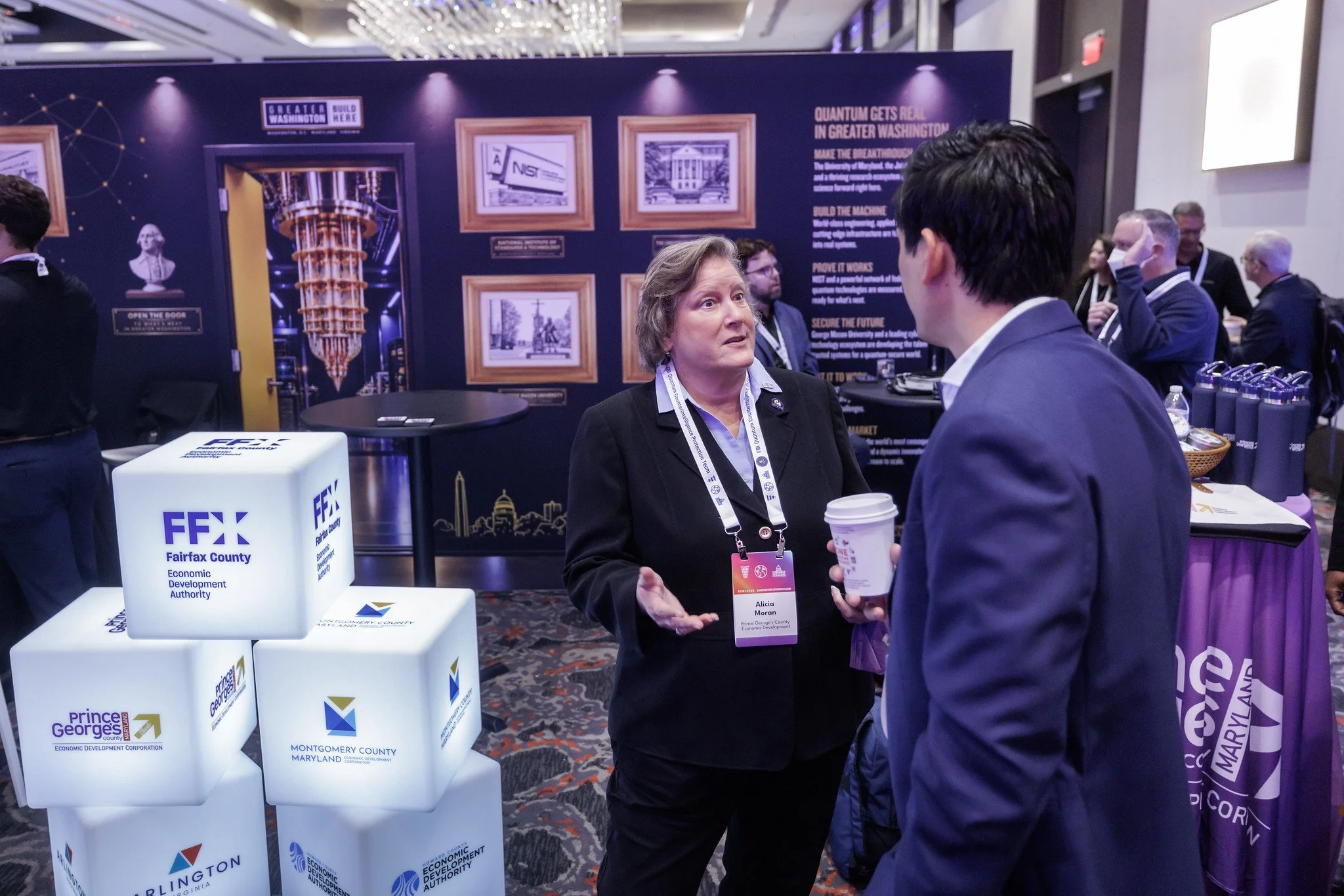
What began as a strategic recommendation had become a visible, sustained example of regional economic development organizations working together.
08 / BUILDING THE NEXT ECONOMY
From Regional Assets to Emerging Industries.
Connected DMV's regional economic development work has always extended beyond REDS.
The broader Strategic Renewal Task Force pursued a portfolio of initiatives addressing technology, infrastructure, resilience, and economic renewal.
That portfolio included efforts in quantum technology, hydrogen, and digital inclusion. These were related initiatives, not all direct outputs of REDS.
Together, however, they reflected the same institutional approach: organize regional capabilities around shared economic challenges and build partnerships capable of addressing them.
QUANTUM
Building a Global Quantum Ecosystem
The Potomac Quantum Innovation Center brought together researchers, industry leaders, federal capabilities, and investors around the region's quantum opportunity.
Launched in 2022, Quantum World Congress has grown into a major international convening. Its 2026 edition in College Park connected global leaders around quantum commercialization, investment, infrastructure, policy, and workforce development.
EXPLORE QUANTUM WORLD CONGRESSSPACE
Building the New Space Economy
Connected DMV's Potomac Center for the New Space Economy connects innovators, policymakers, researchers, buyers, and investors around the industries emerging from space commercialization.
The inaugural spaceNEXT in February 2026 provided a global gathering point for that work, connecting the region to opportunities in commercial space infrastructure, manufacturing, logistics, and investment.
EXPLORE SPACENEXTIn hydrogen, Connected DMV and regional partners also organized cross-sector collaboration and pursued federal funding opportunities to develop regional clean-energy capabilities.
These efforts demonstrate how cross-jurisdictional collaboration can support industry development across multiple sectors.
But building the industries of tomorrow requires more than technological capability. It requires a workforce prepared to power them.
09 / THE TALENT PIPELINE
NEXTversity: Building the Workforce Behind What's Next.
Developing a connected regional talent pipeline was one of REDS's three founding priorities.
Five years later, that challenge remains central to Greater Washington's economic future.
Emerging industries demand new combinations of technical skills, practical experience, and employer-defined competencies. Yet too many prospective workers lack clear pathways into those opportunities.
Connected DMV developed NEXTversity to help address that disconnect.
Built in partnership with Northern Virginia Community College, Prince George's Community College, and the Economic Club of Washington, NEXTversity is an employer-integrated, learn-while-you-earn workforce development framework.
The model connects employer-defined competencies, cohort-based instruction, paid learning experiences, and structured pathways toward employment.
THE NEXTVERSITY WORKFORCE MODEL
Employer-Integrated
Training aligned with the skills employers actually need.
Learn While You Earn
Paid experiences help make advanced training more accessible.
Built Around Cohorts
Structured learning, mentorship, and professional networks.
Connected to Careers
A progression from learning to recognized competencies and employment opportunities.
The framework has been applied through Pathways to Quantum, which Connected DMV reports has generated more than 600 applicants and placed over 80 credentialed graduates into quantum and emerging technology careers over four years.
Reported through Pathways to Quantum, an application of the NEXTversity workforce development framework.
EXPLORE NEXTVERSITYNEXTversity also extends to executive education, helping organizational leaders understand emerging technologies, evaluate opportunities, and prepare for technological change.
Its framework can be adapted across sectors where the skills employers need are evolving faster than traditional training pipelines.
The connection to REDS is not that a 2021 report directly created every subsequent workforce program.
It is that a challenge identified as fundamental to the region's competitiveness is now being addressed through an operational, employer-integrated model.
The region cannot build tomorrow's industries without building tomorrow's workforce.
10 / THE NEXT EVOLUTION
From REDS to RISE.
Today, Connected DMV carries forward this institutional legacy through the Greater Washington Regional Innovation Strategy Engine, or RISE.
RISE builds on the collaboration established through REDS and the DMV Regional Congress, with an increasingly execution-focused emphasis on high-growth industries, infrastructure, regional competitiveness, and workforce pathways.
The regional challenge remains familiar.
Greater Washington possesses extraordinary scientific capabilities, economic assets, institutions, companies, investors, and talent. But possessing those strengths is not the same as organizing them into a lasting competitive advantage.
RISE is designed to help connect regional strategy with practical initiatives, partnerships, and opportunities for coordinated action.
It draws on years of institutional relationships, regional convening, research, strategic planning, and implementation experience.
11 / THE NEXT CHAPTER
The Next Chapter Should Build on the Last.
Five years after REDS 1.0, Greater Washington faces an economic landscape that has changed considerably.
Emerging technologies are reshaping industries. Changing federal priorities are challenging longstanding assumptions about the regional economy. Metropolitan regions around the world are organizing aggressively around talent, infrastructure, innovation, and investment.
The case for stronger regional collaboration has only become more urgent.
There is room—and need—for more institutions, organizations, and leaders to contribute.
But meaningful collaboration should begin with an understanding of the work already done.
Greater Washington has a substantial institutional record of cross-sector economic development work: a published regional strategy, years of steering committee engagement, stakeholder research, federal investment, a comprehensive implementation Playbook, a unified regional brand, and industry and workforce initiatives that continue to evolve.
That history matters. Not because any one organization owns the idea of regional collaboration, but because the region's progress depends on preserving what has been learned, recognizing what has been built, and putting existing capacity to work.
The next generation of regional partnerships should build on those foundations, not overlook them.
Connected DMV remains committed to that work: bringing the right people together, connecting the region's strengths, and building initiatives that expand Greater Washington's economic opportunities.
We've spent years building the foundation. We're building on it every day.
The blueprint was never the destination.
It was the beginning.