
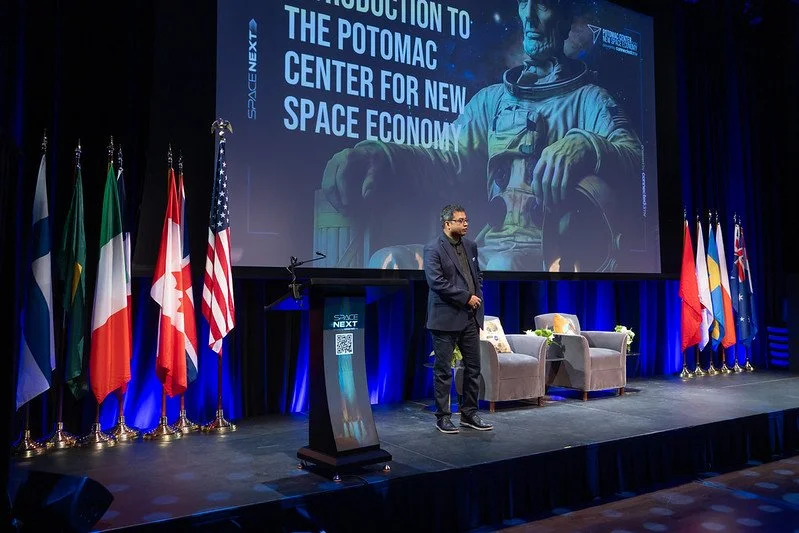
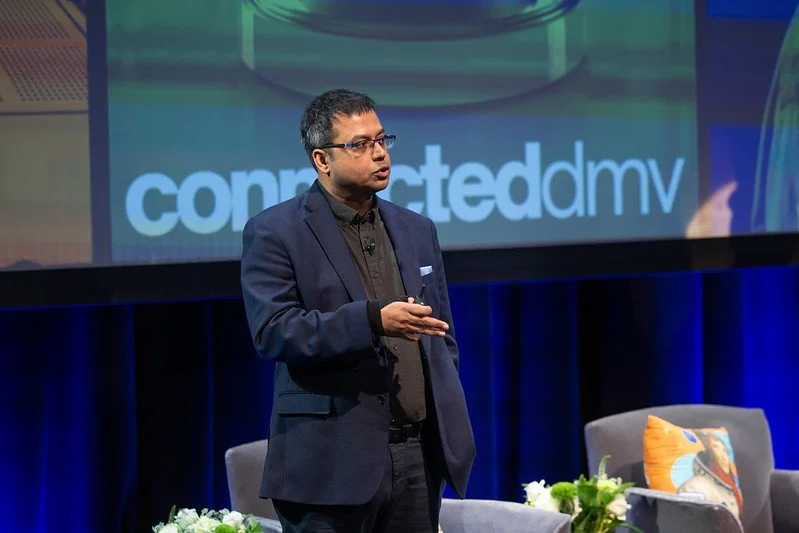
At spaceNEXT 2026, George Thomas, President and CEO of Connected DMV, formally introduced the Potomac Center for the New Space Economy — a new regional platform designed to transform one of the world’s densest concentrations of space assets into a coordinated commercialization engine.
“This is our third effort to build a next-generation industry cluster,” Thomas told the audience. “Energy. Quantum and AI. And now — space.”
Unlike a traditional conference announcement, Thomas’s presentation was a structural argument. The science is ready. The cost curves have shifted. The assets already exist. What has been missing is alignment.
The Inflection Point: Why Now?
For decades, space activity was constrained not by imagination but by cost.
During the Space Shuttle era, launching a kilogram of payload cost between $60,000 and $80,000. Today, that figure has fallen to under $1,000. That collapse, Thomas argued, fundamentally changes what is possible.
“It allows us to rethink not just what we can do in space,” he said, “but what we can do on Earth that can now be done more efficiently, more securely, or more economically because space is accessible.”
For nearly 70 years, the global space economy was effectively supported by a small set of government buyers — primarily defense agencies and national space agencies across roughly a dozen countries. That meant fewer than 30 consistent clients worldwide.
“That’s not an industry,” Thomas said plainly.
What is emerging now, however, is something different: private capital entering the market, commercial buyers forming, and entirely new categories of activity — from in-space manufacturing to orbital infrastructure — becoming economically plausible.
An Asset-Dense Region That Has Never Been Fully Aligned
The National Capital Region, Thomas argued, is uniquely positioned to lead this transition.
The region includes more than 100 federal labs, 17 federally funded research and development centers, nine R1 universities, four NASA facilities, and one of only four built orbital spaceports in the United States. It is home to 177 embassies and local offices of 14 foreign space agencies. The headquarters of the nation’s top aerospace and defense firms are based here.
Add to that the region’s strength in data infrastructure, autonomy, robotics, logistics, and advanced manufacturing — and the picture becomes clear.
“We are one of the densest concentrations of space-related capability and new space economy clients in the world,” Thomas said.
The challenge is not capability. It is coordination.
Historically, these institutions have operated in silos — across state lines, across sectors, and across public and private boundaries. The Potomac Center is designed to function as connective tissue.
From Exploration to Infrastructure
Thomas reframed the conversation about space away from singular missions and toward systems.
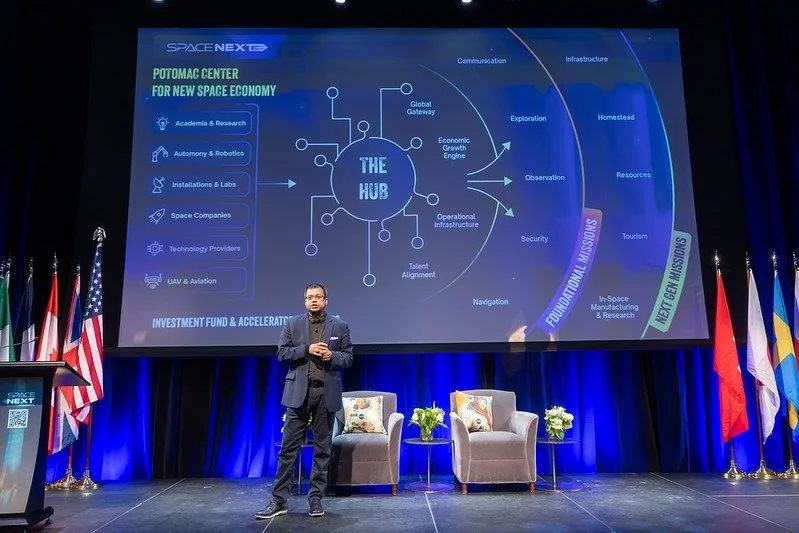
For decades, the foundational missions of space activity have been communication, exploration, observation, security, and navigation. But what lies ahead requires more than mission execution. It requires infrastructure.
In-space manufacturing. Lunar logistics. Resource extraction. Orbital energy systems. Tourism. Refueling networks. Ground-layer integration. New standards and governance frameworks.
“Every major innovation in history has been built on Earth,” Thomas noted. “When we go to space, all of the support structures we take for granted have to be reimagined.”
There are no inherited roads. No legacy utilities. No mature regulatory frameworks. Even fundamental questions — who the buyers are, how value is defined, what financing structures work — must be designed intentionally.
He compared the difference to filming live footage versus creating animation. On Earth, development often captures what already exists. In space, every element must be built deliberately.
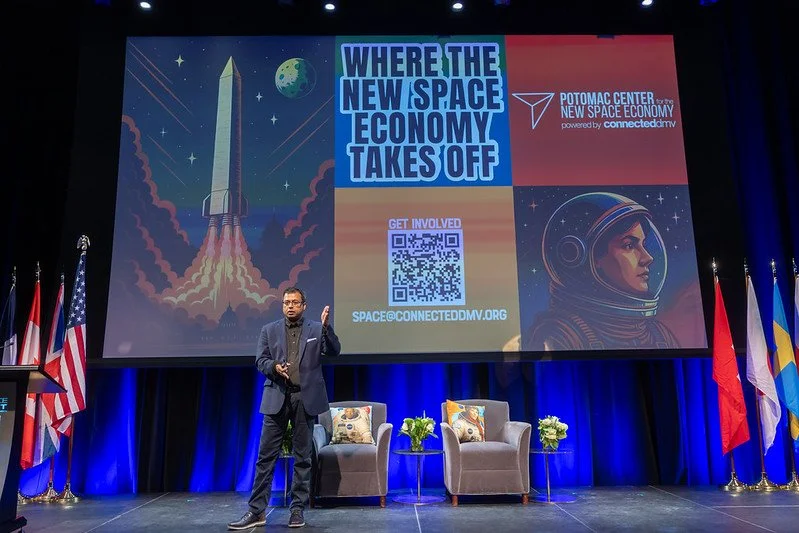
The Hub: Engineering Collisions
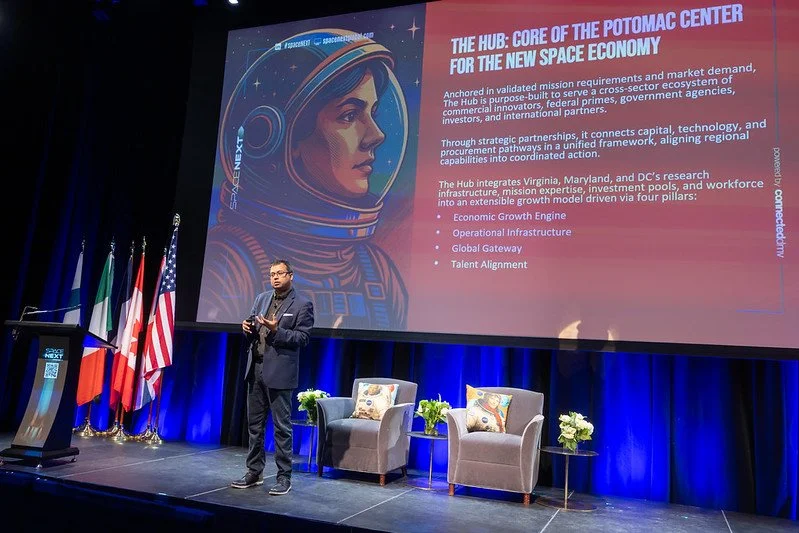
The Potomac Center will operate as a hub designed to bring together four communities that rarely coordinate at scale: builders, buyers, policymakers, and investors.
Thomas described the mission in simple terms.
“Our mission,” he said, “is to make sure more atoms collide.”
That means annual convenings like spaceNEXT, but also year-round solutioning workshops, mission-based conversations, cross-border collaboration, and integrated pathways that connect research, capital, policy, and market demand.
The work will not be quick.
“It’s a decade-long process at best,” Thomas said. “This is not six months and a 10x exit.”
But the timing, he argued, is right. The cost curves have shifted. The engineering base is mature. Capital is available. The question now is whether alignment can keep pace with opportunity.
Building Next — Beyond Earth
Connected DMV was founded with a mission to “build next.” With the launch of the Potomac Center for the New Space Economy, that mandate now extends beyond terrestrial industry.
Thomas closed with a simple thesis: space commercialization will not happen accidentally. It will require intentional ecosystem design — across regions, across nations, and across sectors.
“The science is ready,” he said. “The opportunity is here.”
Now, the work begins.
To learn more about spaceNEXT, please visit spacenextglobal.com.