
Quantum is Now a Government Readiness Issue & A New Report Shows What Leaders Need to Do Next
A new report from the IBM Center for The Business of Government and Connected DMV’s Potomac Quantum Innovation Center examines the global quantum landscape and lays out five priorities for public leaders preparing for the next era of economic competitiveness, cybersecurity, and national security.
Quantum technology is no longer something governments can afford to treat as a distant scientific frontier.
It is becoming a national strategy issue. A cybersecurity issue. A workforce issue. A supply chain issue. An economic competitiveness issue. And increasingly, a question of whether public institutions are preparing fast enough for a technology landscape that is already changing around them.
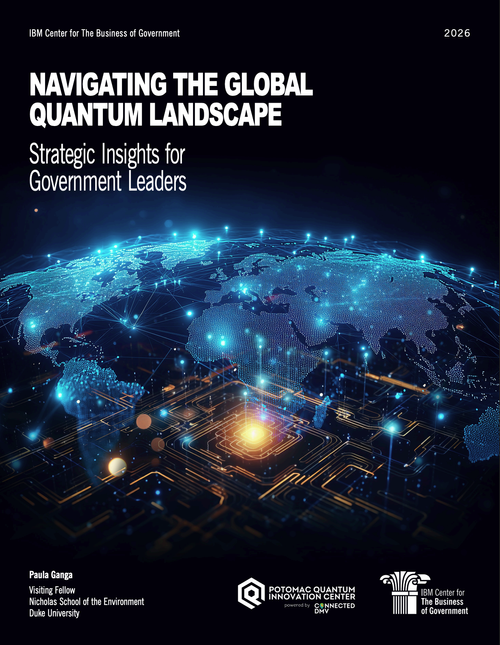
That is why Connected DMV, through the Potomac Quantum Innovation Center, is proud to partner with the IBM Center for The Business of Government on the release of Navigating the Global Quantum Landscape: Strategic Insights for Government Leaders, a new report by Dr. Paula Ganga, Visiting Fellow at Duke University.
The report arrives at an important moment. On June 22, 2026, the White House issued two new quantum-related Executive Orders. One directs federal agencies to accelerate the transition to NIST-approved post-quantum cryptography standards to protect federal systems, sensitive data, critical infrastructure, and the digital economy from future quantum-enabled cyber threats. The other updates the nation’s quantum strategy, with a focus on accelerating quantum computing, sensing, networking, workforce development, commercialization, supply chain resilience, and international partnerships.
In other words: quantum readiness is no longer optional.
The countries, regions, agencies, companies, universities, and ecosystems that are organizing now will have a meaningful advantage in the years ahead. Those that wait will be trying to build strategy, talent, infrastructure, and trust after the pressure is already here.
Navigating the Global Quantum Landscape gives government leaders a practical framework for understanding what is at stake. Rather than treating quantum as a single technology or a single-country race, the report examines five strategic elements across five major global players: the United States, China, the European Union, India, and Australia.
Those five elements are:
Investment
Innovation
Education
Security
Cooperation
Together, they offer a clear way to evaluate national quantum readiness.
The report shows that the United States has significant advantages: world-class research institutions, a strong startup ecosystem, major private-sector leadership, national laboratories, and a decentralized innovation model that has helped fuel discovery. But it also identifies real challenges, including fragmented coordination, funding uncertainty, workforce gaps, supply chain vulnerabilities, and the urgent need to modernize cryptographic systems before quantum risks become operational crises.
Other global players are moving aggressively. China has made major state-directed investments across quantum computing, communications, and sensing. The European Union has built a collaborative research model with strong public investment and deep scientific capacity. India is building foundational capability through targeted national programs and international partnerships. Australia has a long history of quantum research and is working to turn scientific strength into commercial impact.
There is no single model for quantum leadership. But there is a common lesson: quantum progress does not happen by accident.
It requires sustained investment. It requires talent pipelines. It requires public-private coordination. It requires trusted international partnerships. It requires supply chains that can support specialized hardware, materials, cryogenics, photonics, semiconductors, and enabling technologies. And it requires government leaders who understand enough about quantum to make smart decisions before the technology is fully mature.
“The cost of inaction exceeds the cost of sustained engagement.”
That last point matters.
For many public leaders, quantum can still feel abstract. The science is complex. The timelines are uneven. Some applications are already emerging, while others remain years away. But the governance questions are here now.
Which systems rely on cryptography that may become vulnerable?
Which agencies have the workforce needed to understand and manage quantum risk?
Which industries will be most affected by quantum-enabled breakthroughs?
Which partnerships should be built now across government, academia, and industry?
Which regions are organizing the assets needed to compete?
The report makes clear that quantum is broader than quantum computing alone. Quantum sensing could transform navigation, medical imaging, geophysics, defense, infrastructure monitoring, and precision measurement. Quantum communications could reshape secure information exchange. Quantum computing could eventually unlock new capabilities in simulation, optimization, materials science, drug discovery, artificial intelligence, energy, logistics, and national security.
For government, this is not just a technology story. It is an institutional readiness story.
That is also why this work matters to Connected DMV and the Potomac Quantum Innovation Center. The Greater Washington region has a unique role to play in the national quantum landscape. We sit at the intersection of federal mission demand, world-class research, national security priorities, policy leadership, and a growing commercial quantum ecosystem. The region has the ingredients to help translate quantum strategy into implementation, connecting the people and institutions that will shape what comes next.
The report’s recommendations are direct and actionable.
Government leaders should continue investing in quantum research and innovation. They should expand quantum training programs across agencies and beyond traditional technical roles. They should prioritize quantum-resistant encryption and begin migration planning now. They should strengthen domestic and trusted supply chains. And they should deepen collaboration across academic institutions, private companies, national laboratories, state and local partners, and international allies.
The timing could not be more important.
Quantum will shape economic competitiveness, national security, cybersecurity, scientific discovery, and public service delivery for decades. The work ahead will require more than awareness. It will require coordination, investment, trust, and execution.
Navigating the Global Quantum Landscape offers a clear starting point for leaders who need to understand the global context, assess their own readiness, and begin building the partnerships and capabilities this moment demands.
Read the full report from the IBM Center for The Business of Government and the Potomac Quantum Innovation Center: Navigating the Global Quantum Landscape.